Polyfield
- 4.0
- Rating
- 10.00M
- Installs
- Free
- Price
 Analysis by App-foxy
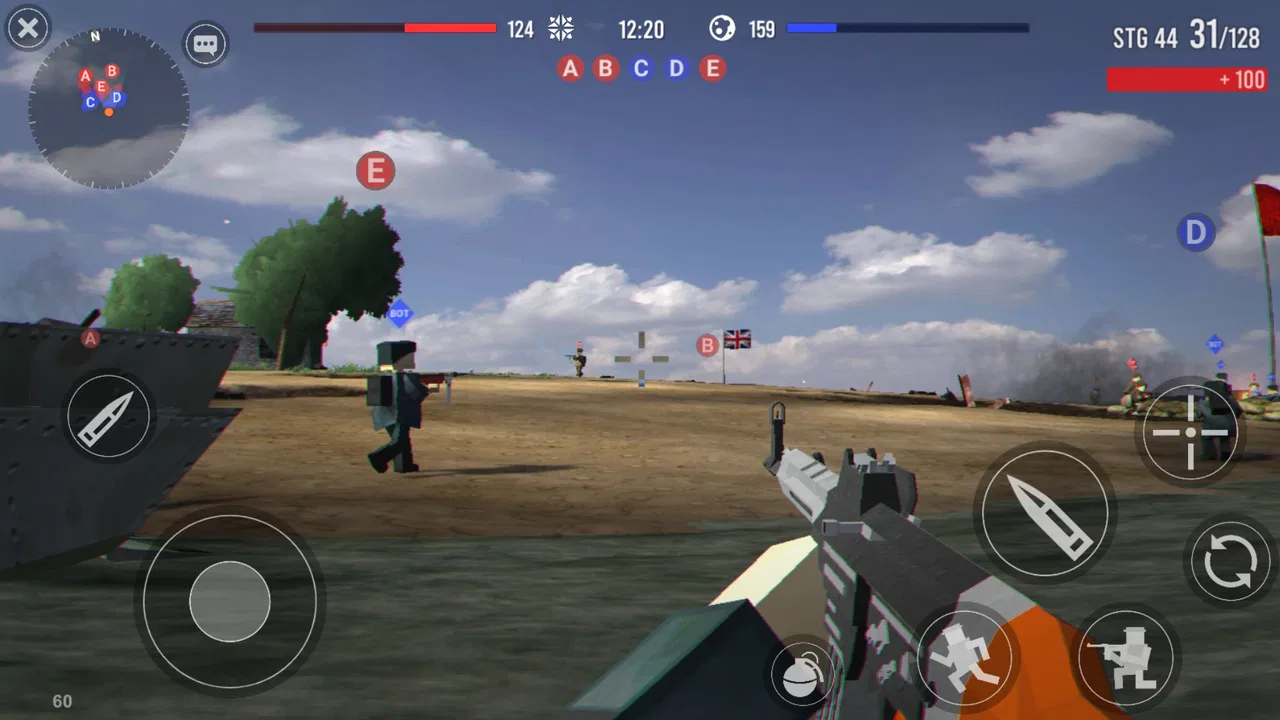
Polyfield is the kind of action game I open when I want a quick taste of large-scale battlefield chaos rather than a slow, carefully scripted campaign. Its central idea is easy to understand: players meet in World War II combat with two teams of thirty-two, creating a much bigger sense of conflict than most mobile shooters. I found that scale to be the main attraction, but it also shapes nearly every weakness. Battles can feel exciting and unpredictable, yet they can also become confusing when several fights happen at once.
The game is free, developed by Mohammad Alizadeh, and aimed at Teen players. It works on Android devices running version 7.0 or later, while the current version is 0.7.3. Its 4.0 average from around 89 thousand ratings and more than 10 million installs suggest that the basic concept has reached a broad audience. I can understand why: Polyfield is straightforward to start, unusual among mobile action games for its team size, and focused on the feeling of being one soldier in a much larger operation.
How Polyfield Turns a Match Into a Clear Goal
The strongest early goal is simply learning how to contribute to a team battle. You are not entering a small arena where every opponent is immediately visible. The action is spread across a battlefield, so your first useful achievement is understanding where the fighting is happening and whether your current position helps your side. That makes the opening matches feel less like a tutorial checklist and more like a practical orientation exercise.
You May Also Like

 Blood Strike: 2.5 Anniversary
Blood Strike’s Loadouts Turn Every Drop Into a Tactical Gamble
A close look at Blood Strike’s custom loadouts: how fast access to signature weapons reshapes its battle royale rhythm, rewards preparation, and narrows the gap between fights.

 Pandora - Music & Podcasts
Pandora’s Music Is Easy to Start, but Harder to Recover
Pandora’s strength is its low-effort path from a seed to a station. Its weak spot is how much confidence it asks you to place in connection, setup, and quiet recovery.

 8 Ball Pool
 Is Built on Rivalries, Rematches, and Routine
A close look at the rivalries, rematches, shared routines, and unanswered safety questions that turn a quick pool match into a persistent mobile community.

 Samsung Music
’s Quiet Strength Is Playing What You Already Own
Its reach comes less from spectacle than from dependable access to a personal library. That simplicity is both the app’s strongest retention engine and its ceiling.

 AccuWeather: Weather Radar
AccuWeather Review: A Quick, Clear Forecast for Everyday Decisions
For everyday plans, the best forecast is the one you can understand quickly. AccuWeather makes rain timing, radar, and local conditions easy to act on, with a few trade-offs.

 Hill Climb Racing
Why Hill Climb Racing Still Turns Crashes Into One More Run
A tiny car, a bumpy hill and one more upgrade: Hill Climb Racing keeps resurfacing because its simple chaos makes every near-miss feel personal.
More From Our News Desk



I recommend beginning with a cautious mindset. Running directly toward the loudest exchange is tempting, but it often gives you very little information about the surrounding area. A better first step is to watch how other players move, notice which routes lead toward active combat, and choose a position that lets you see before committing. This is one of the first non-obvious lessons in Polyfield: survival is not only about fast reactions. It is also about avoiding unnecessary exposure in a battlefield where many players may be approaching from different directions.
The large team format gives early play a useful sense of purpose. Even when I lost an individual encounter, the match still felt connected to something bigger because other players were attacking, defending, and shifting the front nearby. That is different from a tiny deathmatch, where one mistake can make the whole round feel decided by personal performance. Here, a new player can learn by following the flow of the team instead of needing to dominate from the first minute.
At the same time, the game does not make every objective equally obvious through its basic premise alone. In a crowded battle, it is easy to focus on the nearest opponent and forget the wider situation. I found that the best early goal is therefore not chasing eliminations, but building a habit of checking the battlefield before moving. If you enjoy action games that reward immediate aggression above all else, this may feel slower than expected. If you like finding your role inside a larger fight, the scale works in its favor.
What makes the first matches approachable
Polyfield benefits from a low barrier to entry. The World War II setting gives the action a recognizable identity, while the team structure means a beginner does not have to carry the entire match alone. I could join the action, make mistakes, and still understand what I needed to improve: positioning, awareness, timing, and the ability to tell a useful advance from a reckless one.
That does not mean the first sessions are effortless. Large battles can produce a lot of visual and tactical noise. A player who expects a perfectly guided introduction may feel uncertain at first, especially when trying to work out where to go after respawning or how to approach a contested area. My advice is to treat the first few rounds as map-reading practice. Do not judge the game solely by early losses; judge whether you are gradually making better decisions about when to move and when to wait.
A realistic everyday use case is a short evening session after work or school. Polyfield suits someone who wants to play a few battles without committing to a story campaign. You can enter with a simple aim—learn a route, stay with teammates, or improve your timing—and leave with a clearer sense of what went wrong. The experience is less suitable for someone who needs a relaxing game with no pressure, because the constant possibility of being attacked keeps attention high even when the controls are familiar.
Progress Signals Without Losing the Battlefield Focus
One question I had while playing was what keeps the experience moving forward once the novelty of a large World War II battle fades. Polyfield’s strongest progress signal is not a complicated personal journey. It is the improvement you can feel in your decisions. At first, a chaotic match may seem random. Later, you begin to recognize safer approaches, understand when a fight is already lost, and choose moments to support the team instead of arriving too late.
That kind of progress is subtle, but it is meaningful. The game encourages you to compare your behavior from one match to the next. Did you spend less time crossing open ground without cover? Did you avoid repeating the same route after being defeated there? Did you reach the fight sooner because you paid attention to the battlefield rather than wandering? These are practical milestones, and they give the action more depth than simply trying to react faster.
I would not approach Polyfield expecting a heavily layered unlock structure to carry the entire experience. Its appeal comes more from the match itself and from learning how to operate inside a large team. That distinction matters. Players who need frequent rewards, a long list of personal objectives, or a clearly staged campaign may find the progression less satisfying than in a more traditional mobile shooter. Players who enjoy mastering a battlefield through repetition may appreciate that improvement comes from observation and judgment.
The best way to create your own progress path is to choose one focus per session. On one visit, concentrate on staying alive long enough to understand the flow. On another, practice supporting an active push rather than moving alone. Later, try taking a less obvious route or holding a position instead of constantly advancing. This approach prevents every match from blending into the same cycle of running, fighting, and restarting.
Why team size changes personal improvement
In a smaller action game, improvement is often easy to measure because the outcome depends heavily on your direct encounters. Polyfield is different. A player can make a smart choice and still lose the next exchange, or make a poor choice and survive because another teammate draws attention away. That makes progress less clean, but it also makes it more realistic. You are learning to make good decisions under uncertain conditions rather than expecting every correct move to produce an immediate reward.
This is where the game compares favorably with the usual small-arena alternatives. The larger battlefield creates room for support play, repositioning, and patience. However, a compact shooter is usually better if you want rapid feedback from every encounter. Polyfield asks you to accept that your influence may be indirect. That can be satisfying for a player who likes team warfare, but frustrating for anyone who wants every defeat or victory to feel completely personal.
I also found that the scale can hide mistakes. When many players are active, it is not always obvious whether you were defeated because of poor aim, bad positioning, an unexpected approach, or simply being caught at the wrong time. To improve efficiently, pause after each defeat and identify the decision immediately before it. That small habit is more useful than blaming the entire match for feeling chaotic.
Difficulty, Pacing, and the Cost of Staying Engaged
The difficulty curve in Polyfield is shaped less by a formal ladder and more by the growing demands of awareness. The first challenge is learning the controls and basic movement. The next is surviving in a crowded environment. After that, the real test is pacing: knowing when to push, when to regroup with the team, and when an apparently open path is actually dangerous.
This creates an uneven but believable rhythm. Some moments feel quiet enough to let you plan, while others become intense almost immediately. I like that the game does not reduce every second to nonstop close-range combat. The pauses give the battlefield a sense of distance and make a successful approach feel earned. The trade-off is that players accustomed to constant action may interpret these quieter stretches as empty time.
Difficulty also depends on how much uncertainty you tolerate. A match can feel approachable when you move with the wider team, but much harsher when you travel alone or enter a contested area without checking the surroundings. That means the game rewards discipline, though it does not always make the lesson comfortable. The most common frustration is not necessarily losing a duel; it is being defeated before you have a clear idea of where the threat came from.
One practical adjustment is to stop treating every respawn as a command to sprint forward. Use the first few seconds to orient yourself. Look for the direction of nearby activity, identify whether teammates are advancing or retreating, and choose a route that gives you a reason to be there. This reduces wasted lives and gives the match a more deliberate pace. It is a small change, but it makes the large-scale design much easier to appreciate.
Where the action feels strongest
Polyfield is at its best when several layers of action overlap without becoming completely unreadable. A distant exchange can influence your route, a teammate’s movement can make an advance possible, and a seemingly safe position can become exposed as the battle shifts. These moments create the sensation of participating in a broad operation rather than simply appearing in a series of isolated fights.
The weaker moments come when the scale works against clarity. If you prefer precise, immediately understandable engagements, the battlefield may feel too loose. The game does not always provide the same clean feedback as a smaller action title, where you can quickly connect a mistake to a visible opponent. That is an important trade-off, not a minor complaint. Polyfield’s identity depends on confusion and scale, but those same qualities can make it harder to learn efficiently.
Compared with a story-driven World War II game, it offers less personal context and more replayable confrontation. Compared with a conventional mobile deathmatch, it offers a broader sense of movement and teamwork but less control over the entire outcome. I would choose Polyfield for the feeling of joining a battle; I would choose another option when I want a carefully directed narrative, tightly balanced duels, or a highly transparent competitive ranking experience.
What Keeps Players Returning—and Who May Burn Out
The retention pressure comes from the desire to understand the battlefield better. After a difficult match, I often wanted to try again not because a reward screen demanded it, but because I believed I could approach the next battle more intelligently. That is a healthy kind of motivation when it remains voluntary. The game can make a player curious about whether a different route, timing choice, or team position will produce a better result.
Still, this loop has limits. If your matches begin to feel interchangeable, the large-scale format alone may not be enough to keep you engaged. Polyfield works best when you set a personal challenge rather than expecting the game to provide a new dramatic objective every time you play. Try learning how to cross a dangerous area, stay useful during a losing push, or recognize when to stop pursuing a retreating opponent. These goals turn repetition into practice.
The free price makes experimentation easy, especially for players who are unsure whether large team combat belongs on a phone. I would recommend trying it in short sessions first rather than assuming that a few chaotic matches reveal the whole experience. The game rewards a little patience, but it does not suit everyone. Players who dislike online-style unpredictability, frequent interruptions to their plans, or the feeling that teammates influence their success may be happier with a solo action game.
The Teen rating is also worth considering for families choosing games together. The setting is military and the action involves combat, so parents should decide whether that tone fits the player. For older players, the rating communicates that Polyfield is not designed as a gentle, all-ages battlefield toy. I would describe it as accessible in its basic idea but more demanding in its moment-to-moment awareness than its simple presentation might suggest.
Three habits that improve the experience
Use each match to test one decision. Trying to improve everything at once makes the action feel random. Focus on movement, positioning, or timing, then judge the session by that single target.
Follow the battle without blindly following the crowd. Teammates can reveal where pressure is building, but copying every movement may place you in the same danger. Use their direction as information, not as an automatic command.
Review the moments before failure. The useful question is usually not why the opponent was stronger. Ask whether you entered too early, stayed exposed too long, or ignored a change in the nearby fight.
These habits also answer a common concern about whether the game has enough depth beyond its headline concept. The depth is not hidden behind an elaborate menu; it appears in the decisions required to survive and help inside a crowded battle. That depth is real, but it is player-created. If you need constant new equipment, explicit milestones, or a visibly expanding campaign, the experience may feel thin over time.
My Verdict on Polyfield’s Progression and Pacing
After spending time with Polyfield, I see it as a focused action game built around one clear promise: making mobile combat feel large. Its two-team, thirty-two-versus-thirty-two structure gives every match room to breathe, and the World War II setting helps the battles feel distinct from a generic modern arena. The best progress comes from learning how to read that space, not from rushing toward every visible fight.
The game is a good fit for players who enjoy team-based combat, uncertain front lines, and the satisfaction of making a useful decision that may not produce an immediate personal victory. It is especially appealing if you want a free game that can fill a short session while still offering room to improve. The broad audience—reflected in its 4.0 average and more than 10 million installs—makes its accessible premise easy to understand, even though mastering the battlefield takes more patience than the first match suggests.
I would skip it if your ideal action game depends on a strong solo story, perfectly readable one-on-one fights, or a progression system that constantly announces new rewards. Polyfield’s pacing can feel uneven, its large battles can obscure the reasons behind a defeat, and its replay value depends heavily on whether you enjoy self-directed improvement. Those are meaningful limitations, not flaws that disappear because the game is free.
For me, the progression verdict is positive but specific: Polyfield sustains play through battlefield understanding, personal challenges, and the changing flow of team combat rather than through a heavily structured journey. That is enough to make it worth trying, especially for fans of large-scale action on mobile. Go in expecting to learn how to belong in the battle, not to control every outcome, and you are much more likely to enjoy what Mohammad Alizadeh’s game is trying to do.
My recommendation: try Polyfield if the idea of being one soldier in a huge, messy World War II fight sounds more exciting than a neat arena duel. Give it a few thoughtful matches, use the quieter moments to study the battlefield, and decide whether that uncertainty feels engaging or exhausting. For the right player, its scale is the feature that makes the game memorable; for everyone else, it may be the reason to choose a more tightly controlled alternative.
FAQs for Polyfield
01What is Polyfield and what makes it unique?
Polyfield is a first-person shooter game available on Android and iOS that stands out with its low-poly graphics and immersive multiplayer gameplay. Unlike many other mobile shooters, Polyfield focuses on delivering a smooth, fast-paced experience with simple visuals that enhance performance without sacrificing gameplay depth.
02Are there any in-app purchases in Polyfield?
Yes, Polyfield includes in-app purchases. These are primarily for cosmetic upgrades and customization options. While the core gameplay is free, purchasing these items can enhance your visual experience and support the developers. However, they are not necessary to enjoy or succeed in the game.
03What devices are compatible with Polyfield?
Polyfield is designed to run on most modern Android and iOS devices. However, to ensure optimal performance, it is recommended to use devices with at least 2GB of RAM and a decent GPU. Check the app store page for specific compatibility details related to your device.
04Does Polyfield require an internet connection to play?
Yes, Polyfield primarily focuses on multiplayer gameplay, which requires an active internet connection. The game connects you with players worldwide for real-time matches. While some features may be accessible offline, the core experience is designed for online play.
05How does Polyfield handle updates and new content?
Polyfield regularly receives updates that include new maps, weapons, and gameplay features. The developers actively engage with the community to gather feedback and implement improvements. Ensuring your app is updated will provide the best experience and access to the latest content.
Pros
- Smooth and intuitive controls enhance gameplay.
- Impressive graphics for an immersive experience.
- Varied maps keep the game feeling fresh.
- Frequent updates with new features.
- Supports multiplayer for competitive fun.
Cons
- Occasional lag in high-traffic areas.
- Limited character customization options.
- In-app purchases can be pricey.
- Requires stable internet connection.
- Soundtrack can become repetitive.

Polyfield
Gallery